We're living in a time where AI can write emails, blogs, create content and sometimes, it's hard to tell whether a human or a machine is behind it all. While that can be exciting, it also raises an important question: How do we know what's real anymore?
That's where authenticity comes in.
This guide isn't about fearing AI. It's about understanding it, using it responsibly and knowing how to check whether content is genuinely human or machine made. Whether you're a writer, marketer, student, content creator or just someone who values honest content, learning how to verify it can protect your credibility and sharpen your voice in a noisy digital world.
Let's break it down, simply and honestly.
Understanding AI Content: What's Really Going On?
AI hasn't just dipped its toes into content creation; it's fully immersed. Today's tools can write anything from quick summaries to long form articles to extremely believable pictures and videos that appear as surprisingly human.
Behind the scenes, these systems work by spotting patterns. They predict what word should come next based on massive amounts of existing content like books, websites, articles and more. That's why AI created content often feels smooth and confident.
But here's the catch: AI doesn't understand what it's saying or what it's supposed to show. It doesn't think, feel or truly know context the way humans do. It can sound right while being subtly wrong, repetitive or shallow. That gap is where authenticity starts to matter.
As AI-generated content becomes easier to create, the risk of misinformation, recycled ideas and credibility loss grows. Knowing how AI works helps you stay alert and intentional about what you create and consume at the same time.

Why Authenticity Still Matters (More Than Ever)
People can sense when something feels real.
Authentic content builds trust. It tells your audience, "There's a human behind this who cares." And trust is everything, especially online, where attention is short and skepticism is high.
When content feels honest and thoughtful, people stay longer, engage more and come back. For creators and brands, authenticity is more than just a value but a competitive advantage.
Amongst these, there's also a practical side: Search engines reward originality. Content that feels generic, duplicated or mass produced is more likely to be ignored or worse, penalized. Being authentic helps both your audience and your visibility.
Tools That Help Check AI-Generated Content
Luckily, however, as AI content has significantly grown, so have tools designed to spot it.
Platforms like WeCatchAI focus on transparency and human review, rather than just throwing out a mysterious percentage score. That "human-in-the-loop" approach adds context; something machines alone can't provide.
You sign in and become a community member. Then upload certain content that you find odd. State why you think it's AI generated and let other community members vote, with them stating their reasons as well. This inclusion of human insight is what's rare in such AI detection tools.
WeCatchAI not only includes humans but also gives an opportunity to run a Deep Analysis on the uploaded content, thereby mixing human reasoning and AI efficiency. If you ask me, this is the future of AI detector tools.
Other tools look for patterns common in AI writing, while plagiarism checkers can flag content that feels overly familiar or recycled. None of these tools are perfect on their own, but together, they offer useful signals.
Think of them as assistants rather than judges.
How to Judge Content Quality (Even Without Tools)
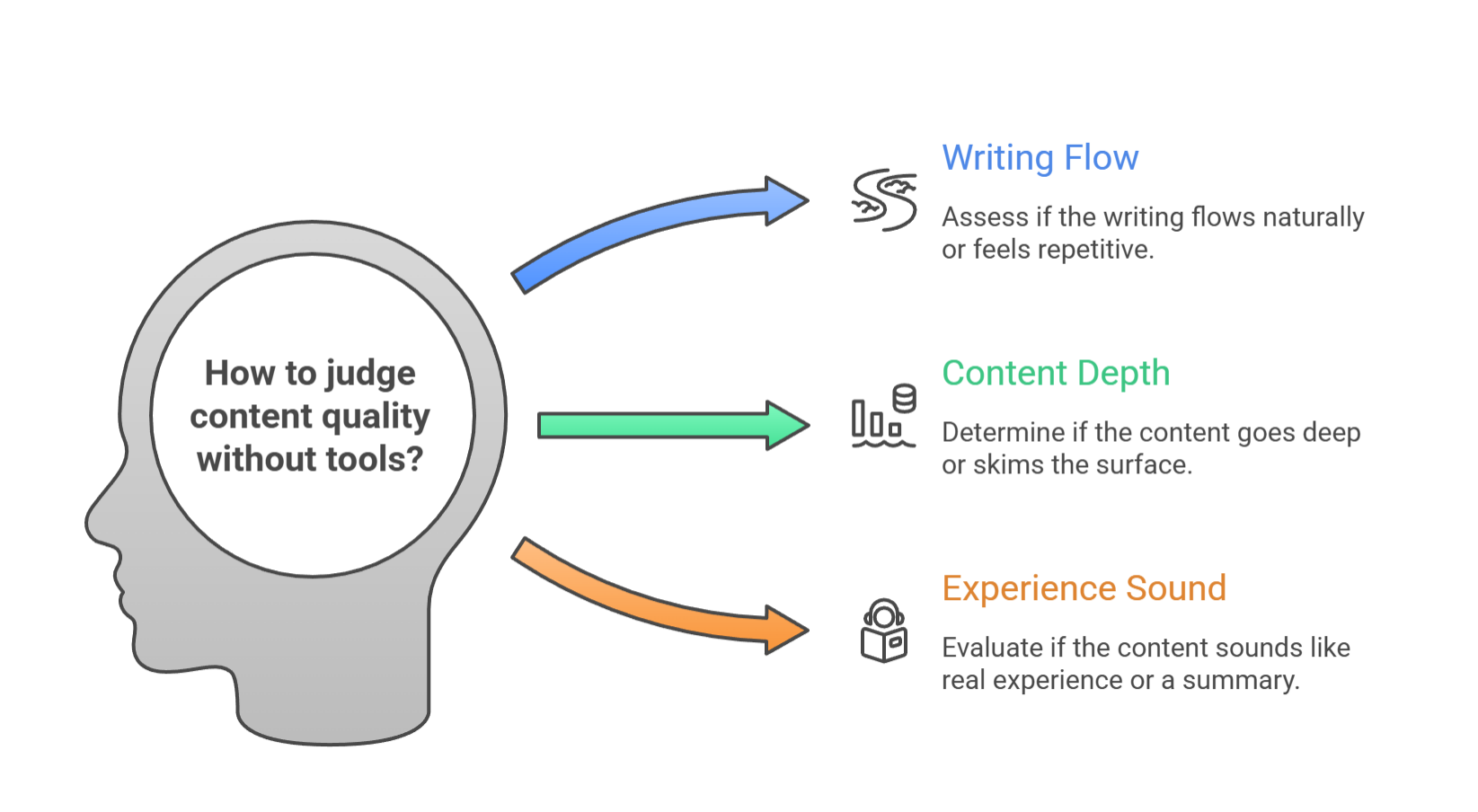
The thing is, you don't always need software to sense when something's off. After writing several blogs of my own, I can now understand when content feels off. It's simple.
Ask yourself:
- Does the writing flow naturally or does it feel oddly repetitive?
- Does the content go deep or just skim the surface?
- Does it sound like someone with real experience or like a polished summary of things already said?
Human made content usually carries tiny imperfections, opinions and insights that feel lived in. AI content more often than not feels too clean, too balanced and most importantly, emotionally flat.
The trick is to trust your instincts. They're more powerful than you think.
Free Ways to Verify Authenticity (For Videos & Images)
You don't need paid tools; just slow down and look closely.
- Reverse search a screenshot using Google Images or Lens. If it shows up elsewhere or in a different context, that's a red flag.
- Watch for visual glitches like odd blinking, warped hands or strange lighting shifts.
- Check the voice and lip sync, robotic tones or mismatched movement often signal manipulation.
Real content isn't perfect. If something feels too smooth or off, trust that instinct.
Common Signs the Content Might Just Be AI-Generated
Watch out for:
- Repeated phrases or ideas that say the same thing in slightly different ways.
- Confident statements that lack real insight or examples.
- A tone that shifts unexpectedly.
- Writing that sounds polished but strangely empty.
- Check for distortion of fingers and eyes in the case of pictures and videos.
AI can imitate structure but depth is still very human.
AI Content vs Human Content: The Real Difference
AI is fast. Humans are meaningful.
Machines can generate volumes of text in seconds. A polished video or picture in minutes. Humans bring lived experience, emotion, intuition and perspective. That's why human content often feels warmer, messier and more memorable.
The future isn't about choosing one over the other but about using AI as a tool, not a replacement.
The Role of AI in the Modern Content Strategy
I'm gonna be honest here. Used wisely, AI can definitely save time, spark ideas and handle repetitive tasks. It can help you brainstorm, summarize or even optimize; but it shouldn't replace your voice.
The strongest content strategies keep humans in control. Editing, reviewing and shaping AI-assisted content ensures it still sounds like you.
Efficiency matters. But integrity matters more.
What the Future Holds
AI will only get better at sounding human. That means verification, ethics and transparency will matter even more.
We're already seeing a push toward responsible AI, clearer disclosures and stronger detection methods. The goal isn't to reject AI but to use it honestly.
That is the reason tools like WeCatchAI exist.
Final Thoughts: Staying Real in an AI World
In the coming future, Authenticity will not be about proving you didn't use AI but about making sure your content still reflects thought, care and intention.
When you understand how AI works and where it falls short, you're better equipped to create content that feels real, trustworthy and human.
AI can help you speak louder.
But authenticity makes people listen.
And that's something no machine can replace.
Ready to Verify Content?
Join our community of truth-seekers. Submit suspicious content, vote on authenticity, and help build a more trustworthy internet.
Start Detecting AI Content